
A professional study based on measurement data recorded in an industrial application using a certified measurement system
Hungarian National Electric Heating Association (MOEFSZ)
Introduction
Opportunities for an objective comparison of heating technologies are rare under conditions in which the measurement parameters are fully controlled and professionally certified. The present study is outstanding in this respect, as it was carried out at the privately owned site of an energy company, on 2 containers of identical base construction, using the certified measurement system they provided, over several weeks with minute-by-minute recording.
The market player participating in the measurements is a leading domestic actor in the energy industry, specialising in the construction of energy networks and systems, and within this also in the measurement, calibration and laboratory testing of electrical and energy systems. Thanks to this professional background, the data underlying the present study are accurate, consistent and of industrial-grade reliability. The task of MOEFSZ was to process, interpret and professionally evaluate these measurement results from the perspective of comparing heating systems.
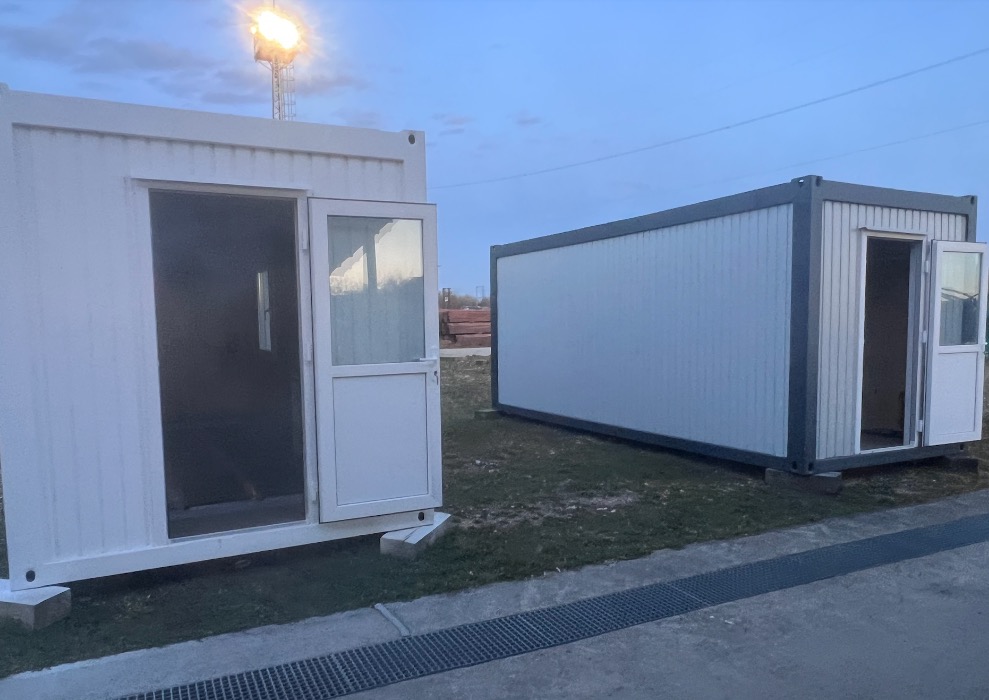
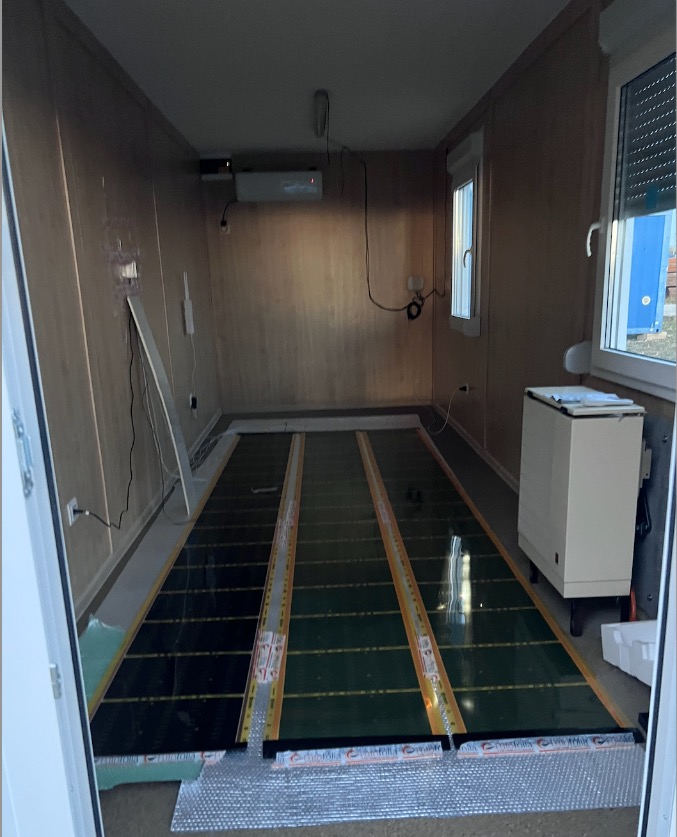
Within the framework of a series of tests comprising several different comparative examinations, the comparative study of the heating systems was also carried out. The aim of the study was to demonstrate how heating-cooling air-conditioning air heating behaves in an insulated office container representing real-world use, and how radiant infrared heating, the 4th-generation heating film, behaves in the same place. The measurement took place over two separate, full 14–14-day periods:
- air-conditioning heating: 14–28 October 2025,
- infrared heating: 4–17 November 2025.
In both periods, the industrial partner's precision measurement systems recorded the outdoor temperature, the indoor temperature at several points, and the energy consumption every minute. In this study the container had no thermal insulation coating, so the results show the cleanest possible thermal behaviour regardless of the heating method.
1. The role of outdoor temperature conditions in interpreting consumption
The two heating technologies did not operate under identical weather conditions. Based on the industrial partner's precise temperature measurements:
- the average outdoor temperature of the air-conditioning period: 10.2 °C,
- the average of the infrared heating period: 7.0 °C.
The difference of 3.2 °C is significant, because the heating demand is, to a good approximation, proportional to the difference between the indoor and outdoor temperature (ΔT). Assuming a target temperature of 21 °C, the following formulas result:
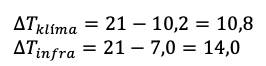
The ratio between the heat loads of the two periods:
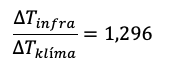
This expresses that during the colder period the heating demand is nearly 30% higher, regardless of the heating system. Therefore, the raw consumption data of the infrared heating had to be weather-corrected so that purely the technological difference between the systems would be apparent.
2. The behaviour of air-conditioning air heating over the 14-day measurement cycle
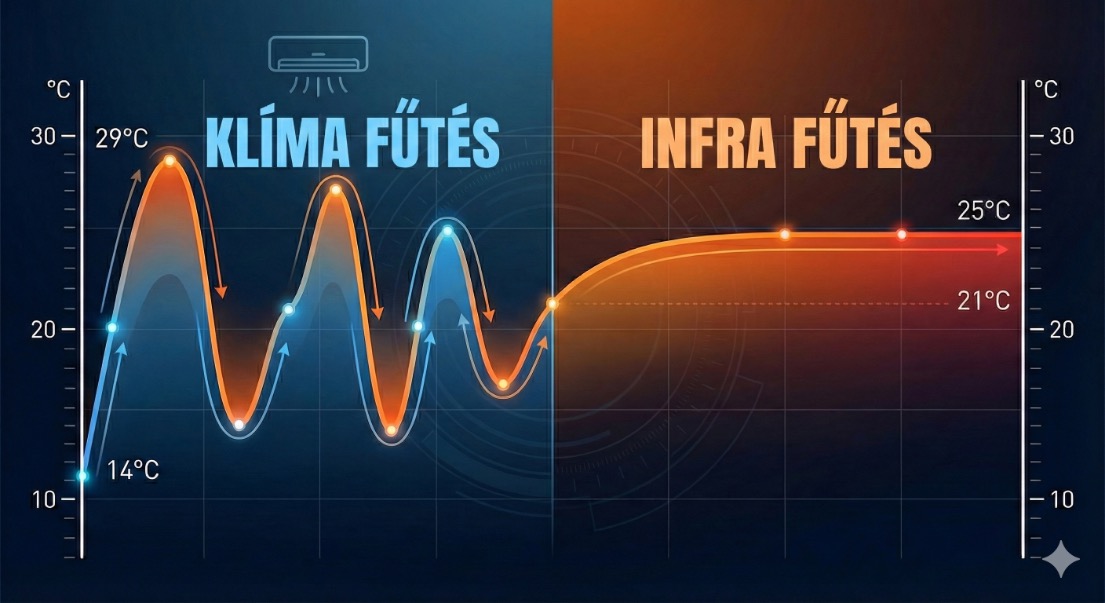
Based on the industrial partner's measurements, air-conditioning heating showed strong temperature fluctuation. The indoor temperature varied between a lower limit of 14–15 °C and an upper value between 27–29 °C. This can mean a swing of as much as 10–12 °C within a single day.
It is a phenomenon arising from air heating that the air conditioner heats the air quickly, and then, when the thermostat switches off, the temperature cools back down quickly — especially with uninsulated walls. Based on the data, the temperature measured near the wall was consistently lower, with an average difference of –0.37 °C and a large standard deviation. This clearly expresses the cold radiation of the walls and the comfort disadvantage of air-based heating.
The specific energy consumption of air-conditioning heating: 150.01 kWh/day
3. The behaviour of infrared heating over the 14-day measurement cycle
The temperature behaviour of the infrared heating, the heating film, differed markedly. The daily temperature fluctuation was typically 1–2 °C, and the measured values stabilised between 21–25 °C. This stems from the nature of radiant heating: the system primarily warms the surfaces — floor, walls, furniture — which give off even and long-lasting heat.
The wall-to-centre temperature difference dropped to –0.31 °C with infrared heating, with a smaller standard deviation, which shows a more homogeneous warming of the space.
The raw energy demand of infrared heating: 213.1 kWh/day
4. Scientific correction of energy consumption
4.1. Weather correction (equalising ΔT)
For a correct comparison, the infrared consumption must be adjusted to the heat demand of the air-conditioning period. Its correction factor is:
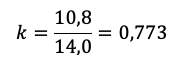
The corrected infrared consumption:

4.2. Comfort correction (the same perceived warmth at a lower air temperature)
It is a physiological property of radiant heating that it provides the same comfort sensation even at an air temperature 2–3 °C lower, because the perceived warmth depends not on the air but on the temperature of the surfaces.
This means a further 14–22% energy saving:
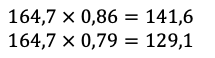
Thus, adjusted to reality, the infrared consumption falls between 129–142 kWh/day.
5. Perceived warmth and the role of radiant heat
Radiant infrared heating does not focus on warming the air, but on raising the temperature of the surrounding surfaces and objects. This provides a more favourable comfort sensation even when the air temperature is lower.
Radiant heat has well-documented positive physiological effects:
- it improves micro- and peripheral circulation,
- it reduces muscle tension and joint stiffness,
- it creates a natural, soft sensation of warmth, comparable to the feeling of the sun's warmth.
Air-conditioning heating, by contrast, moves the air, which:
- circulates dust and allergens,
- creates draughts,
- dries out the air,
- results in uneven comfort.

6. Differences in maintenance, reliability and service life
The air conditioner is a complex mechanical unit that contains moving parts, a compressor, fans, filters and refrigerant. It requires annual servicing and, due to its points of failure, has an average service life of 8–12 years.
The 4th-generation heating film, by contrast:
- contains no moving parts,
- has no filters, fans or compressors,
- its maintenance requirement is practically zero,
- the chance of failure is minimal,
- its expected service life is 50–60 years.
The durability and operational reliability are incomparably more favourable in favour of radiant heating.
7. Other technical, economic and health differences between the two heating systems
The operation of air-conditioning air heating requires an outdoor and an indoor unit, which emit noise, take up space and can also be aesthetically disturbing. The unit's filters require regular cleaning and disinfection, and a refrigerant leak can pose an environmental risk.
Infrared heating:
- is a completely concealed system,
- is silent,
- is modular and easily expandable,
- contains no refrigerant or environmentally harmful substances,
- creates no air movement during operation, which is particularly beneficial for allergy sufferers.
There is also an essential difference in terms of perceived warmth: air-conditioning air heating relies on the rapid heating and circulation of the air, whereas radiant infrared heating relies on the heat of the surfaces and the direct radiation acting on the body. In practice, this means that radiant heating provides far more balanced and natural thermal comfort.
8. Environmental impact, CO₂ footprint and sustainability considerations
The environmental impact of heating systems arises not only from the energy used during operation, but also from the burden occurring throughout their entire life cycle. This includes manufacturing, transport, operation, maintenance, and the amount of waste generated at the end of the product's life.
Based on the measurements, the energy demand of infrared heating and air-conditioning heating — after temperature and comfort correction — can fall within the same range; at the same time, there are significant differences between the service life and maintenance requirements of the two systems, which in the long term also affect the burden on the environment.
The expected service life of infrared heating films is 50–60 years, which is more than four times the average 8–12-year life cycle of air conditioners. This means that over the service life of a single infrared heating system, four to five air conditioners would have to be manufactured, serviced and then handled as waste if someone chooses air heating.
During operation, the heating film contains no refrigerant, compressor or other component that could entail environmentally harmful emissions. The F-gases originating from refrigerant leaks in air conditioners have a significant global warming potential (GWP), which is why these are strictly regulated substances.
Owing to the long service life, the minimal failure rate and the practically zero maintenance requirement, the environmental burden of infrared heating over the entire life cycle is substantially lower. The CO₂ footprint associated with the system is orders of magnitude more favourable, because:
- fewer devices need to be manufactured,
- fewer machines need to be transported,
- there is less electrical waste at the end of the service life,
- there is no refrigerant handling or F-gas emission,
- there are no chemicals or cleaning agents required for maintenance,
- during operation the energy demand is lower if it is set according to perceived warmth.
Summarising these, it can be stated that:
“Over the entire life cycle, infrared heating causes only a fraction of the environmental burden of air-conditioning heating, since, thanks to its multiple service life, it replaces 4–5 devices while producing no refrigerant-related emissions.”
This is a professionally defensible statement that can be used alike in:
- technical documentation,
- green energy tenders,
- environmental communication,
- the HEM programme.
9. Life-cycle environmental burden and HEM eligibility
Infrared heating shows favourable thermal and comfort properties not only during operation, but also represents a substantially lower environmental burden over its entire life cycle. The expected service life of the heating film is 50–60 years, which is more than four times the typical 8–12-year operating time of air conditioners. This means that during a single installation of infrared heating, in the case of an air-conditioning system 4–5 separate devices would have to be manufactured, serviced and then handled as waste.
Due to the F-gas content of the refrigerants used in air-conditioning technology, even a small amount of leakage carries a significant global warming potential, whereas infrared heating contains neither refrigerant nor moving parts. The absence of maintenance further reduces the emissions and waste arising over the life cycle. The reduced air temperature enabled by the perceived-warmth advantages can further increase the energy saving.
Based on these factors, infrared heating can be aligned in several respects with the energy and sustainability criteria of the Certified Energy Savings Balance (HEM). The long service life, the low operating cost, the maintenance-free nature and the refrigerant-free operation together result in the system's ecological footprint over the entire life cycle being a fraction of that of air-conditioning heating.
10. Extended professional summary (final evaluation)
The complete study, carried out in the industrial partner's accredited environment and evaluated by MOEFSZ on the basis of the high-resolution measurement data they provided, clearly demonstrated:
- The temperature of air-conditioning air heating fluctuated greatly, the walls remained cold, and comfort was unstable. According to the measurements, the indoor temperature moved between 14–29 °C, meaning that the temperature fluctuation often reached the range of 10–12 °C.
- The temperature of infrared heating was orders of magnitude more stable, both in space and in time. A smaller standard deviation within the min–max range of 21–25 °C, i.e. the fluctuation typically remained within 1–2 °C.
- The standard deviation of the wall-to-centre difference:
with air-conditioning ~0.37 °C deviation, with large swings, with infrared an average of ~0.31 °C, with a significantly smaller standard deviation. This temperature stability is one of the main advantages of radiant heating.
- The raw consumption data are misleading (213.1 kWh/day) due to the colder weather; this had to be corrected. After applying the temperature ΔT correction. Thus the corrected consumption, projected onto identical weather conditions, is 164.7 kWh/day. The air conditioning, without correction, is 150.1 kWh/day. At this point the professional analysis already allows a clean comparison.
- The air conditioner requires annual maintenance, its mechanical parts wear out, and its average service life is 8–12 years.
- In real-world use, infrared can save a further 15–22% energy due to the differences in perceived warmth.
General supplementary advantages that cannot be directly demonstrated from the measurement results…
- The infrared heating film is maintenance-free, has no moving parts, and its service life can be as much as 50–60 years.
- Radiant heat has a more favourable effect on the human body, does not move dust, does not dry out the air, and does not cause draughts.
- The air conditioner is visible and noisy, the outdoor unit can fail; infrared is concealed, quiet and simple.
- Based on the measurements, infrared heating proved to be a more stable, healthier, more operationally reliable and more economical solution in the long term.
FINAL CONCLUSION, conclusions regarding the on-site configuration
In light of the results, it can be stated that, due to the special configuration of the containers, only the heating conditions and results can be meaningfully evaluated, since the use of air conditioners is unavoidable given the summer conditions; however, clearly, owing to a more positive development of occupational health and working conditions, the use of supplementary infrared heating is more advisable. The 4th-generation heating film demonstrably achieves a faster “heated comfort sensation,” which even means energy savings. Accordingly, the use of infrared heating can be recommended — in the case of industrial-use containers, primarily as ceiling heating in order to avoid damage, instead of the bottled-gas heating option traditionally installed in the container. This could significantly improve heating operational reliability, reduce air depletion, and thereby simultaneously improve working conditions.